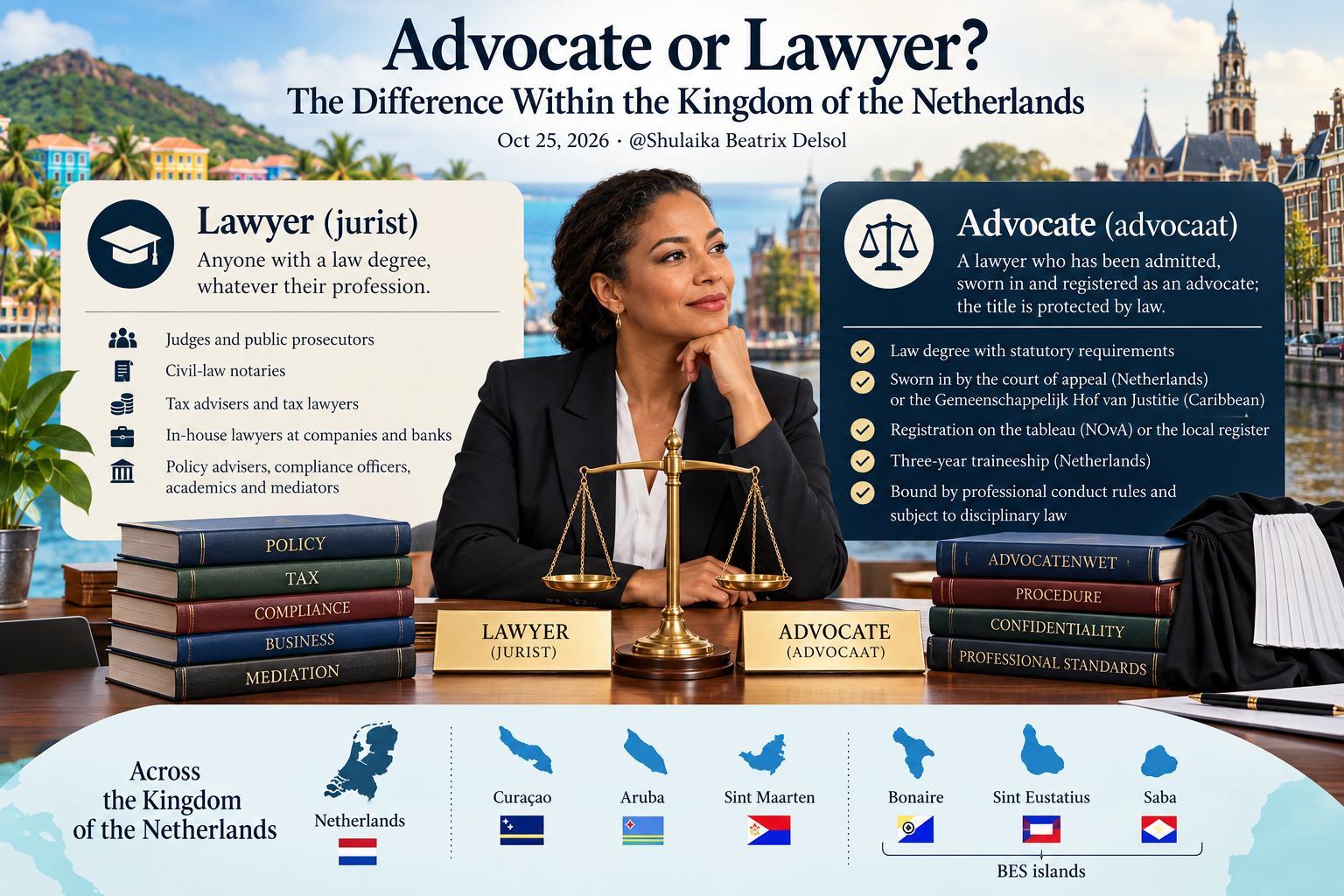
Every advocate is a lawyer, but not every lawyer is an advocate. In my practice across Curaçao, Aruba, Sint Maarten, Bonaire and the Netherlands, clients often ask me what the difference is, and whether they need an advocate for their matter. The answer affects who may represent you, which professional rules protect you, and what your matter will cost.
In this article I explain the distinction in plain terms, and how it works in the different countries and public bodies of the Kingdom of the Netherlands.
The lawyer: a law degree, many professions
In Dutch, a lawyer in the broad sense is a jurist: someone with a law degree. A law degree opens the door to many professions, most of which never involve appearing in court:
- judges and public prosecutors;
- civil-law notaries;
- tax advisers and tax lawyers;
- in-house lawyers at companies and banks;
- policy advisers, compliance officers, academics and mediators.
A law degree on its own does not lead to registration in any register of advocates. Several of these professions have their own admission rules and supervisors, such as notaries and judges. Others, such as tax advisers, are not regulated by statute, and membership of a professional body is voluntary.
The advocate in the European Netherlands
An advocate is a lawyer who has met additional statutory requirements. In the European Netherlands, these include:
- a law degree that meets the statutory requirements for access to the legal professions (civiel effect);
- being sworn in by the court of appeal;
- registration on the tableau of the NOvA, the public-law professional body for advocates;
- a three-year traineeship under a supervising advocate, including NOvA's professional training programme.
On registration, the advocate receives a BAR-nummer. BAR stands for Beheer Advocaten Registratie, the NOvA team that keeps the register. The number is an administrative identifier: the NOvA may not use citizen service numbers, so it assigns its own. It is used, among other things, for the advocate's electronic pass, which gives secure access to digital court systems.
Registration brings obligations. Advocates are bound by the Advocatenwet and professional conduct rules, owe a duty of confidentiality, must maintain professional liability insurance and keep up their training, and are subject to disciplinary law. Anyone can check whether a person is registered through the NOvA's public search (NOvA – tableau).
The advocate in Curaçao, Aruba, Sint Maarten and the BES islands
Curaçao, Aruba and Sint Maarten are separate countries within the Kingdom, each with its own legislation. Bonaire, Sint Eustatius and Saba have their own BES legislation. The NOvA and its BAR-nummer do not apply there.
In these jurisdictions, admission runs through the Gemeenschappelijk Hof van Justitie:
- the applicant applies to the Hof in writing to be registered as an advocate;
- the Hof hears the procureur-generaal and obtains advice from the Raad van Toezicht;
- the advocate is sworn in at a public session of the Hof and is entered on the list kept by its registry.
In Curaçao this is governed by the Advocatenlandsverordening 1959 (consolidated text, P.B. 2026, no. 66), and for the BES islands by the Advocatenwet BES (Stb. 2010, 511). Aruba and Sint Maarten have their own rules. Local bar associations, such as the Orde van Advocaten Curaçao, represent advocates on each island.
The principle is the same throughout the Kingdom: an advocate's status rests on statute, admission by a court, a public oath and public registration.
When you need an advocate, and when you do not
Whether you need an advocate depends on the proceedings and the jurisdiction.
An advocate is generally required where the law prescribes mandatory representation. In the European Netherlands, this applies to most civil proceedings before the district court (outside the sub-district court), the court of appeal and the Supreme Court.
An advocate is often not required for:
- tax objections and many tax appeals;
- administrative objections and appeals;
- smaller civil claims, employment and rental cases before the sub-district court in the Netherlands;
- advice on contracts, business structures, estate planning and tax planning.
In those matters, you may act yourself or be assisted by another qualified lawyer or tax adviser. The rules differ between the Netherlands, Curaçao, Aruba, Sint Maarten and the BES islands, so check them for your specific case before you choose.
Choosing the right professional
When you choose legal help, ask three questions: Who may act in my proceedings? Which professional rules protect me? Does this person know the law of my jurisdiction?
I personally handle each matter, from tax objections and business restructuring to contracts, estate planning and asset protection across the Kingdom. I look for creative, timely and lawful solutions, and I tell you clearly when another professional is required.
Would you like to know what applies to your situation? Book a consultation, email me at info@shulaikadelsol.com, or visit www.shulaikadelsol.com to learn more.
This article provides general information and is not legal advice for your specific situation.